

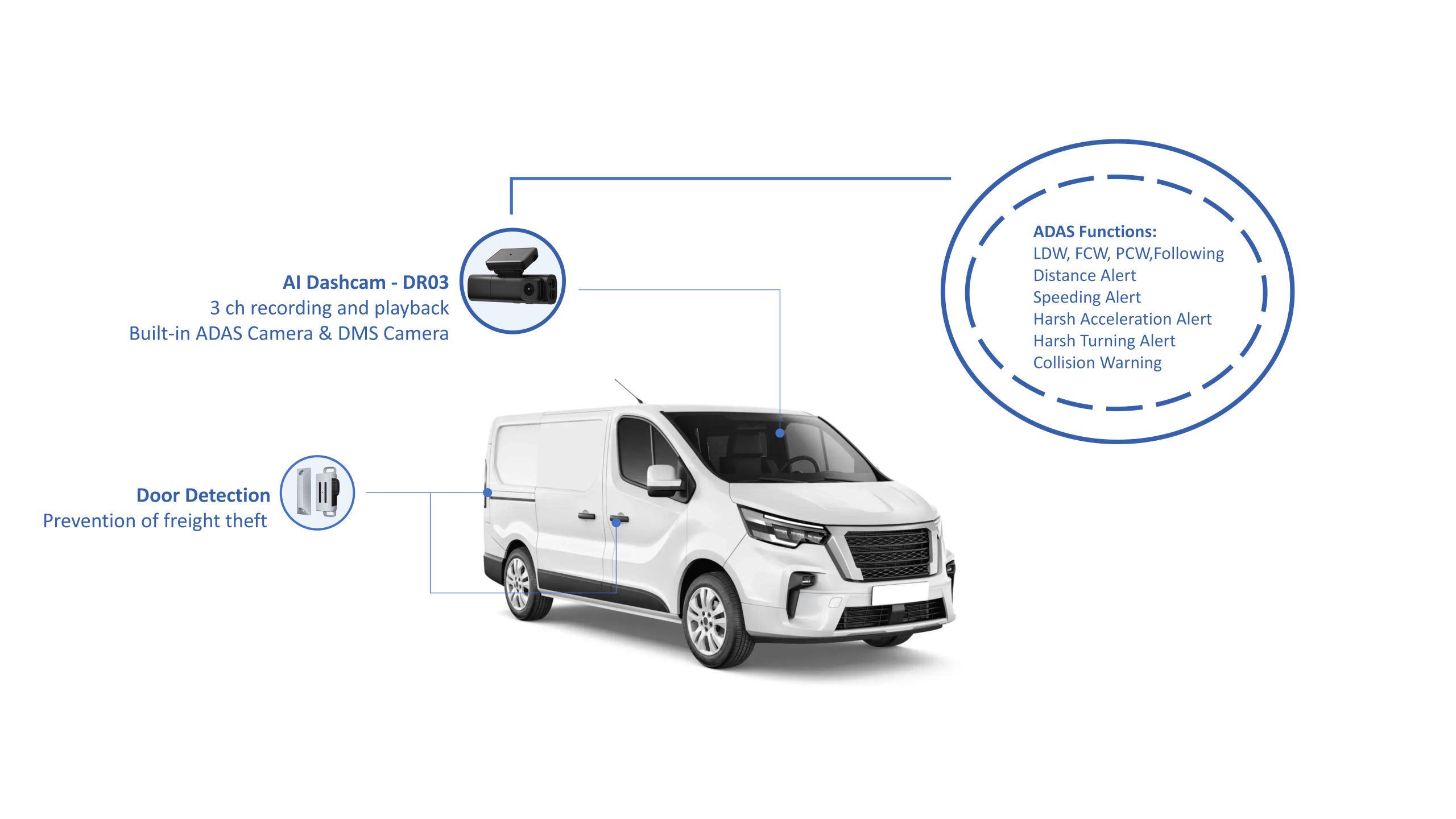
Problem statement: visibility gaps that cost hours and dollars
Operators face three measurable problems: undocumented incidents, unclear maintenance triggers, and route inefficiencies that inflate fuel and labor costs. Remote sites and long haul routes—onshore and offshore stretches such as the Gulf of Mexico—amplify those issues because human supervision is sparse and telemetry alone misses contextual cues. A modern approach combines edge video with telematics; an AI dashcam captures visual events while automated tagging reduces manual review. When you pair that with a purpose-built fleet camera system, you convert blind spots into analyzable signals.
Key metrics to track (and why they matter)
Measure these KPIs and you’ll link cameras to operational impact:- Incident frequency per 100,000 miles: identifies safety trends and training needs.- Mean time to incident validation (minutes): shows how quickly video confirms severity.- Idle time and fuel burn per trip: reveals driver behavior and route choices.- Diagnostic-triggered maintenance versus scheduled maintenance ratio: highlights predictive maintenance opportunity.- Video-to-alert ratio after edge filtering: gauges signal quality and bandwidth efficiency.Track these metrics weekly to spot shifts; treat them as inputs to model-driven decisions rather than raw scores.
How camera-derived data becomes actionable
Raw video is heavy; you need a pipeline. First, edge models flag events (hard braking, near-miss, roll stability, blind spot alerts). Next, event metadata (timestamp, GPS, CAN bus snapshot) streams to a central store. Correlate events with maintenance logs and fuel records. Use simple models to score drivers and vehicles, then run periodic root-cause analyses on high-score events. The process converts a laterally spread set of issues into ranked, solvable problems.
Practical deployment rules that avoid common failures
Teams often fail by doing one of these things:- Over-collecting: storing every minute of footage without event labels—creates review backlog.- Misplacing cameras: wrong angles miss occlusions or fail to capture license plates.- Ignoring bandwidth: no plan for offload windows causes data gaps.- Skipping governance: unclear retention and access rules expose privacy and compliance risk.Mitigations: enable edge filtering to store only indexed events, validate camera FOV during commissioning, schedule bulk uploads during low-usage windows, and document retention and role-based access policies before roll-out.
Analytics architecture that scales
Design a minimal, repeatable stack:1) Edge inference for event detection and compression.2) Time-series database for telematics and event metadata.3) Object store for conditional video retrieval.4) Correlation layer to join CAN/OBD, GPS, fuel, and video events.5) Dashboards with alerting thresholds and interrogation workflows for investigators.Keep models simple initially: binary event classifiers and anomaly detectors. Iterate with labeled events to improve precision and reduce false positives.
Behavioral and maintenance interventions that show results
Use camera-backed evidence to change behavior and schedule repairs. Replace anecdote-driven coaching with quantified feedback: show the driver the event clip, present the corresponding braking score, and assign a focused training module. For vehicles, prioritize maintenance when video shows repeated hard-shock events coupled with diagnostic codes. These targeted actions shorten repair cycles and reduce repeat incidents.
Common questions decision-makers ask
Will video overload analysts? No—edge labeling and strict retention rules cut the review load by an order of magnitude. Is privacy a blocker? Not if you apply masking, strict access controls, and clear retention policies. Does ROI appear quickly? Expect operational signals (reduced validation time, fewer unnecessary callouts) within weeks and safety trends within a few months when metrics are tracked consistently.
Final synthesis
Start by defining the precise problem you need to solve, instrument only the signals that matter, and enforce governance so data remains usable and trusted. That discipline turns cameras from a passive archive into a source of quantified actions—shorter downtime, faster incident validation, and clearer maintenance priorities—an approach supported by experienced operators and field deployments. For integrated camera analytics that map directly to those outcomes, vendors such as BSJ supply the components and deployment patterns teams use to make the data operational.
