

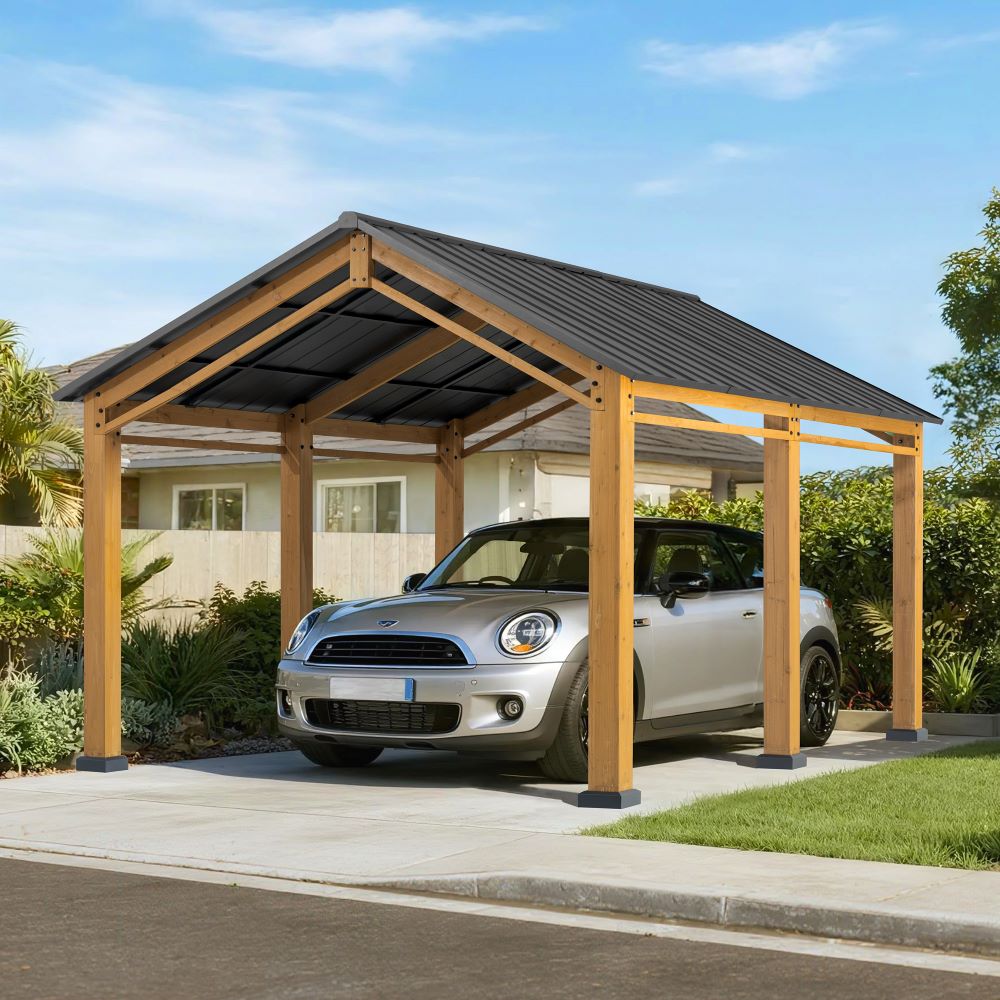
The practical side of Sunjoy Carports: the available installation footprint for RV or trailer storage
For vehicle owners planning covered parking, SUNJOY carports are best considered as a space-planning decision before they become a product decision. The central question is not simply whether a shelter can cover an RV or trailer. It is whether the intended installation area can accommodate the vehicle, the approach to the space, and the way you expect to use the surrounding area.

Start with the space you actually have
Begin by describing the use case in plain terms. Is the planned footprint for an RV, a trailer, another vehicle, or equipment? The SUNJOY collection discusses carports for vehicles, RVs, and equipment, while also presenting possible uses such as an outdoor workspace, shaded patio, or storage area. That range makes the surrounding space important: a location planned for occasional parking may be assessed differently from one expected to support storage or regular outdoor activity.
Measure the area available for the proposed installation, then consider how the vehicle reaches it. A useful planning record can include the vehicle’s overall length and width, the direction of approach, nearby walls or fences, and any space needed to open doors or access stored items. These are planning prompts, not dimensions supplied by the collection page. They help you compare the shelter footprint with the real conditions of your property rather than judging a listing by its title alone.
Separate listed details from footprint assumptions
The collection page describes kits as including pre-cut parts, hardware, and step-by-step instructions. That tells you how the page presents the kit contents. It does not, by itself, establish that every model has the same dimensions, clearance, anchoring arrangement, or suitability for a particular RV or trailer. Those are separate questions tied to the selected model and the installation location.
The same distinction applies to construction language. The page describes steel frames and weather-resistant roofing as features of metal carports. This is the website’s description of those features, not an independent durability or storm-resistance guarantee. Treat the wording as product-page information to compare, while keeping the physical footprint and local site conditions as separate parts of the decision.
Use a comparison that matches your intended use
When reviewing carports for sale, compare each candidate against the job the space must perform. A vehicle-only plan may focus on whether the covered area aligns with the parked vehicle. A storage plan may also need room to reach equipment. A workspace or shaded patio plan changes the question again, because usable space around the vehicle may matter as much as the roofed area.
Do not assume that a broader use description means every model supports every use in the same way. The collection page presents several possible applications at category level. Your comparison should therefore stay specific: record the selected model’s stated dimensions and features, then place those details beside your own site measurements. This avoids turning a category description into a promise about a particular product.
| Page-listed point | How it helps with footprint planning | Boundary to keep in mind |
|---|---|---|
| Vehicles, RVs, or equipment are discussed as possible uses | Use the actual item being covered to define the planning scenario. | The category description does not select a model or establish its fit. |
| Pre-cut parts, hardware, and step-by-step instructions are described as kit contents | Include the kit format in your purchase comparison. | Kit contents do not state the available installation dimensions. |
| Steel frames and weather-resistant roofing are described as metal-carport features | Record the construction labels alongside the footprint information. | The description is not an independent guarantee of durability or storm resistance. |
Turn the page review into a practical check
Before choosing a model, make a short comparison sheet with four sections: intended vehicle or equipment, available installation area, access around the planned position, and details stated on the selected product page. Keeping these sections separate helps prevent a common mistake: using a construction label or a general use category as a substitute for a site-fit decision.
It is also useful to distinguish the footprint of the shelter from the footprint of the whole activity. If the space will support storage, think about how items will be brought in and taken out. If it will remain primarily for parking, consider how the vehicle will enter, leave, and sit in the planned position. If the space may later serve as a workspace or shaded patio, note that as a separate use rather than assuming the parking arrangement automatically provides comfortable working room.
Finally, compare the selected model’s stated information with the measurements and access notes you recorded. The collection page supports a starting framework: it presents vehicle, RV, and equipment uses; describes kit contents; and identifies steel frames and weather-resistant roofing as listed features. The practical decision is to match those page-listed details to the specific footprint you have available.
| Page-listed point | How it helps with footprint planning | Boundary to keep in mind |
|---|---|---|
| Vehicles, RVs, or equipment are discussed as possible uses | Use the actual item being covered to define the planning scenario. | The category description does not select a model or establish its fit. |
| Pre-cut parts, hardware, and step-by-step instructions are described as kit contents | Include the kit format in your purchase comparison. | Kit contents do not state the available installation dimensions. |
| Steel frames and weather-resistant roofing are described as metal-carport features | Record the construction labels alongside the footprint information. | The description is not an independent guarantee of durability or storm resistance. |
A measured next step
For a vehicle owner, the most useful next step is to sketch the proposed position, record the vehicle or trailer dimensions, and mark the approach and surrounding obstacles. Then use the selected listing to fill in the model-specific details rather than relying on category wording alone. SUNJOY can be part of that comparison, provided the final choice is based on the relationship between the stated product information and the space you intend to use.
